TOP 10 FINALIST
BOSTON TECH WEEK 2026
FDA REGULATORY COPILOT
Can we catch the questions a regulatory team has not asked yet?
I built ApprovalOS, a working prototype that helps drug development teams challenge assumptions, spot evidence gaps, and see where experts disagree before a big decision.
One question, reviewed from several angles
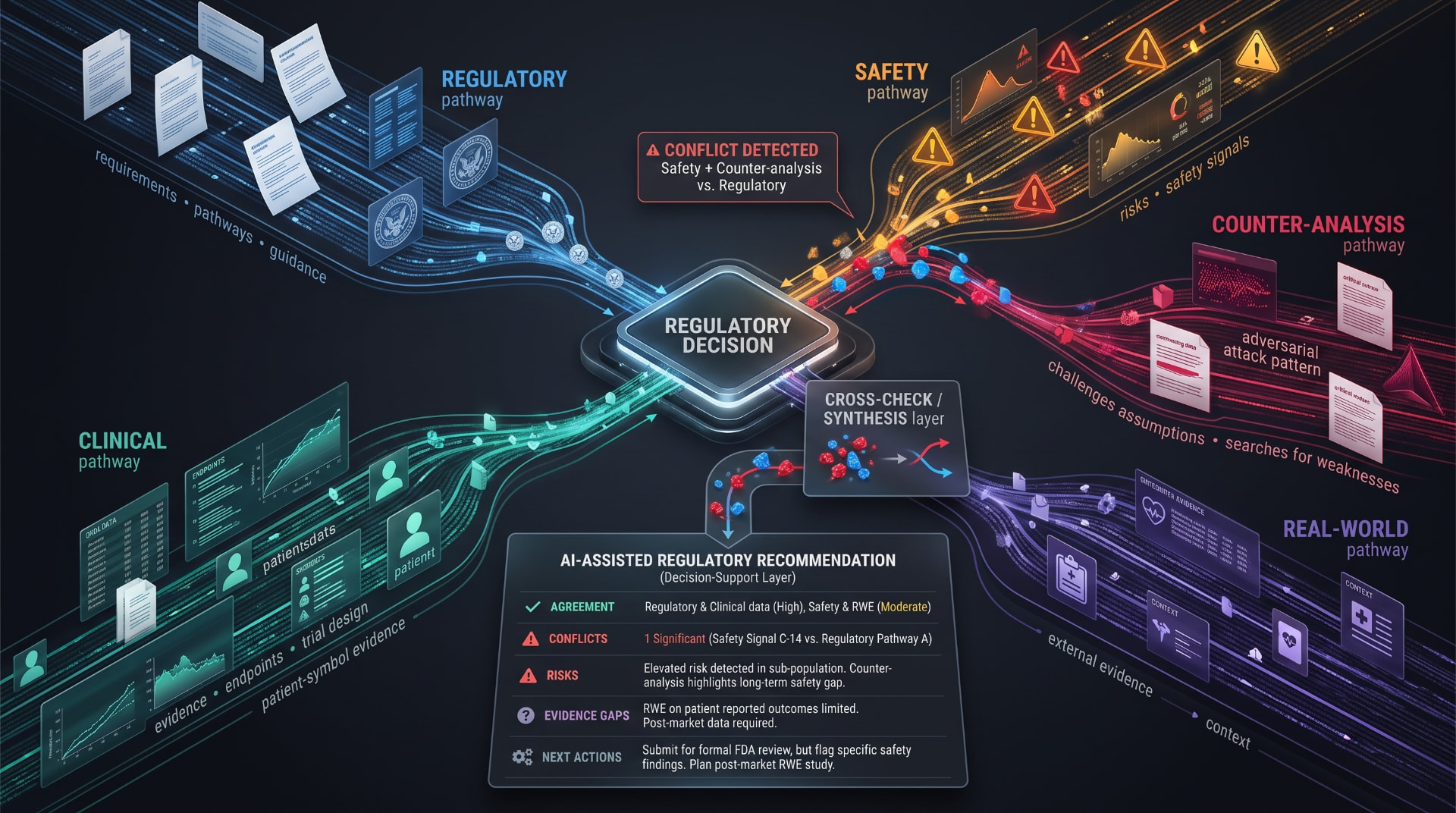
ApprovalOS asks several specialized AI agents to review the same regulatory question. Instead of one confident answer, it shows where the agents agree, where they disagree, what evidence is missing, and what to check next.
Question
What decision is the team making?
Independent review
How does each specialist see it?
Conflict detection
Where do they disagree?
Next action
What should the team check first?
Where should the team look first?
The product is built around one question: where should the team focus first?
Where should we look first?
The dashboard puts readiness, risk, agent agreement, evidence gaps, and top issues in one view. It helps the team pick a starting point before diving into the full analysis.
What does each perspective think?
Each specialist reviews the same question from a different angle. The product keeps disagreement visible instead of blending it into one answer.
Regulatory
Low risk
Clinical
Medium risk
Safety
High risk
Counter-analysis
High risk
Conflict detected — Safety and Counter-analysis disagree with Regulatory
Illustrative output. A disagreement is more useful than five green checkmarks. It tells the team exactly where to look first.
What questions might come up?
Teams can explore possible review questions before a formal submission. It's a scenario-planning tool, not a prediction of what FDA will decide.
What changes if an assumption fails?
The scenario view lets a team compare a base case with alternatives and see what evidence they'd need if a key assumption changes.
Who owns the next step?
| Risk | Severity | Confidence | Evidence | Owner | Next action |
|---|---|---|---|---|---|
| Primary endpoint may be challenged | High | Medium | Clinical + counter-analysis | Clinical lead | Pre-specify sensitivity analysis |
| Safety signal in subgroup needs characterization | High | Low | Safety agent, thin sourcing | Safety | Pull subgroup data; expert validation |
| Pathway assumption not documented | Medium | High | Regulatory guidance references | Reg. affairs | Confirm with consultant |
Illustrative output. Each risk gets a severity, confidence level, evidence, an owner, and a next action, so the review turns into work, not more text.
How did we get to this conclusion?
The audit trail shows the path from question to evidence, conflict, synthesis, and decision. It supports review, but it doesn't make the system legally compliant on its own.
Confident is not the same as challenged
A single model can give you an answer. That doesn't mean the answer has been challenged.
ApprovalOS uses different specialist perspectives to make disagreement visible. That doesn't mean more agents are automatically more accurate. The goal is to give experts a better way to find shaky assumptions, missing evidence, and questions worth digging into.
Regulatory
Checks the pathway, requirements, and relevant guidance.
Clinical
Looks at the evidence, endpoints, and trial design.
Safety
Looks for potential safety risks and signals.
Real-world
Adds context from real-world use and outside evidence.
Counter-analysis
Tries to poke holes in the argument and catch what the other agents missed.
From domain question to working product
I worked with an FDA regulatory consultant to understand the workflow and the decisions teams have to make. Then I turned that into the product concept, agent structure, review experience, and working prototype.
I framed
The problem, the user workflow, and the product hypothesis.
I designed
The agent responsibilities, review flow, risk outputs, and audit trail.
I built
The ApprovalOS prototype and the product walkthrough.
I am not an FDA regulatory expert. The consultant helped me understand the domain. My contribution was product strategy, system design, experience design, and prototype development.
The information exists. Bringing it together is hard.
Regulatory teams already have plenty of information. The hard part is pulling clinical, safety, regulatory, and real-world evidence together before a decision.
Each specialist can be right about their own area while the team still misses an important assumption.
~8.5 yrs
Study and testing before approval
FDA estimates roughly 8.5 years of study and testing before a new drug can be approved.
<10%
Drugs entering trials that are approved
FDA materials state fewer than 10% of drugs entering clinical trials are eventually approved.
$0.6–2.7B
Estimated development cost range
FDA materials describe drug development as expensive and risky, citing an estimated range of $0.6B–$2.7B.
Additional industry context
$4,682,003
FY2026 PDUFA application fee for an application requiring clinical data. Source: FDA. This is a filing fee, not the cost of an application, and not an amount ApprovalOS has saved.
A setback can also create more clinical work, analysis, consulting, legal and compliance work, CRO costs, resubmission work, and delay. These are illustrative categories, not measured product outcomes.
Can experts find useful risks faster?
The first thing I'd test: do experts find useful risks faster with ApprovalOS than with a standard review alone?
Control
Human expert review alone
Treatment
Human expert review with ApprovalOS
Primary metric
High-value risks identified
Secondary metrics
Review time, evidence gaps found, false positives, and expert confidence
Experts consistently find the surfaced risks useful without being overwhelmed by noise.
The system produces too many low-value alerts. Narrow the product and tighten what gets escalated.
Experts cannot separate useful signal from AI-generated noise after the product is narrowed.
This is a proposed experiment using matched historical or synthetic scenarios. No customer result, accuracy result, or FDA validation is claimed.
The value is catching a big issue earlier
It would likely sell to biotech companies, emerging pharma teams, or regulatory groups working on high-value development programs.
The business case isn't that AI replaces experts. It's that catching one important issue earlier can save time, rework, and expensive delays.
Illustrative expected-value model
Synthetic — not a customer ROI calculationExpected exposure
$5M × 20%
$1M
Illustrative expected-value ratio vs software cost
10.0×
Program value at risk ($25M) sets the ceiling on what a setback can touch. It's context, not part of the ratio.
This model only shows how the economics would have to work. The real product still has to prove it can catch issues experts would otherwise miss.
Experts need to see how it got there
Source traceability
Every conclusion points back to the evidence behind it.
Independent review
Each perspective reviews the question before seeing the others.
Visible disagreement
Conflicts stay visible instead of getting averaged away.
Audit trail
A reviewer can see how the system reached its conclusion.
Human decision
The system raises questions. Experts still call the shots.
Clear uncertainty
Confidence and evidence strength are stated, not implied.
ApprovalOS is decision support. It doesn't replace regulatory experts, predict FDA decisions, or make an output compliant on its own.
Trust is part of the product.
In a regulated setting, people need to see where an answer came from.
Disagreement can be useful.
A conflict between perspectives can matter more than five confident green checkmarks.
AI should help people decide, not just talk.
The goal isn't more text. It's helping an expert decide what to look at next.
The supporting thinking
The product story comes first. These sections hold the deeper assumptions and methodology for anyone who wants to dig in.
How the agents work together
- Regulatory question
- Independent specialist reviews
- Cross-check
- Conflict detection
- Counter-analysis
- Expert review
The system keeps disagreement visible long enough for a human to inspect it. It then organizes agreements, conflicts, evidence gaps, risks, and next actions instead of collapsing everything into one long response.
Product hypothesis, not an accuracy claim. More agents don't automatically mean a better answer.
Detailed industry context
- Additional clinical work
- Additional analysis
- Consulting
- Regulatory strategy
- Legal / compliance work
- CRO costs
- Operational delay
- Resubmission effort
- Delayed revenue
- Opportunity cost
These are illustrative categories of work a regulatory setback can trigger. The FDA filing fee is separate from those costs and shouldn't be treated as a savings claim for ApprovalOS.
Economic assumptions
The interactive model compares hypothetical rework exposure with hypothetical software cost. It's a way to ask whether the problem could support a business, not evidence that ApprovalOS has saved money or produced customer ROI.
Product evolution
V1
AI answer
V2
Multi-agent analysis
V3
Multi-agent + conflict detection
V4
Simulation + risk register
V5
Auditable decision support